Study Away Programs offer many benefits as well as drawbacks. The most important step in preparing to study abroad is to figure out whether or not it will be worthwhile it for you to go. While the Study Away Office at Missouri State wants to assist you in planning a great international experience, we do understand that the disadvantages may sometimes outweigh the advantages; however, nearly every student who has studied abroad with Missouri State has come back to us with extremely positive feedback.
Pros:
There are many benefits that come from studying abroad while in college. These should certainly be considered when choosing whether or not to go.
Cultural experience. Students who study abroad get to experience first-hand the lifestyles and traditions of people in cultures completely foreign to their own. Not only is this a fascinating and fun experience, it can help students be more sympathetic to others with different views from their own.
Language learning. Students who are studying a foreign language can excel immensely when learning from native speakers. This is the easiest way to achieve fluency.
Independence. College is a good way to stretch ties with parents or guardians, but spending time abroad is a great way to learn self-reliance on a completely different level.
Meet people. Not only will students be able to meet peers on their program, they will be able to meet locals. One of the best experiences of studying away is making new friends worldwide.
Travel. Many people desire to see the world, and study abroad is a great way to do it! Other places of interest may be much cheaper and more accessible to students from their host countries as well.
Course opportunities. Some students may have the opportunity to study courses not offered by Missouri State which may be beneficial to their area of study.
Résumé builder. Many employers and graduate programs are happy to accept people with cultural experiences such as study abroad.
Learn about yourself in another culture. By immersing yourself into another culture, you can find out a lot about your role or niche in different societies.
Cons:
There are also cons associated with studying away, and it is important for students to be aware of these in the decision-making process.
Culture shock. Students may feel overwhelmed when first entering a new culture, but many forget the idea of reverse culture-shock as well. Re-entry into one’s home country can bring about thoughts of having missed out and feelings of disconnectedness from loved-ones.
Academic transfers. Certain classes may not transfer back to Missouri State properly unless the student completes the correct paperwork. The Study Away Office can assist you in this process.
Academic challenges. Some students may find classes in other countries to be much more difficult, especially when taught in another language.
Finances. Studying abroad is commonly more expensive than a regular semester at Missouri State. On top of this, exchange rates and increased cost of living in certain regions may cause financial problems. Nevertheless, Missouri State allows students to apply scholarships and financial aid toward approved study away programs. There are also other scholarships and grants available. Furthermore, beginning for incoming Freshmen and West Plains transfer students in fall 2009, Missouri State will be offering a new study away voucher. See the Study Away scholarship homepage for more information.
Separation from family, friends, and partners. This can leave students feeling alone, out of touch, or unsure of what to do in case of family emergencies. However, communication technology has increased immensely and this can help with separation anxiety.
Discrimination. While many cultures do not have problems with the differences people possess, some students may feel discriminated against for being American as well as possible other issues such as gender, race, religion, or sexual orientation. Missouri State does not discriminate based upon any of these factors (see the Non-Discrimination Policy Statement).
Hopefully, now you have been able to determine whether or not studying abroad is the right move for you. If you still want to go, the next step is to figure out which program best fits your needs.
There are many considerations you need to be aware of when choosing a program. Not every program is right for every person, but keeping these in mind will help you find the one that is right for you.
What you want. Where are you interested in studying and traveling? Why? Do you want to study in a metropolitan city, or a small town? Would you want to spend a semester, year, or other amount of time studying away? List as many requests as you can before you begin looking for host sites.
Your field of study. Your advisor can help you figure out the best time to study abroad, and he or she may even know of institutions abroad which offer your major.
Language requirements. Does the program you want require or recommend language proficiency? You may have to take two or more semesters of a given language in order to study in your country of choice. It is always helpful to know at least some of the language, however, even if you are not required to know it for program acceptance.
Competitiveness of the program. Certain programs may be more difficult to get into than others. The Study Away Office staff can help you determine which programs are harder to get into, and we will help you with your application when the time comes.
Credit transfer. Is this program approved by the Missouri State Study Away Office? If so, you will be guaranteed elective credit. Nevertheless, you may have to fill out equivalency forms in order to receive specific MSU credit for your courses.
Money. Will you be able to afford the costs involved with this program? Is there a less-expensive option? If this program is approved by the Missouri State Study Away Office, you can use your financial aid or scholarships towards the program.
After you have chosen a program, the next step is to complete an application package. The application process for studying abroad varies from program to program. Some only require a filled out form and a deposit, while others require essays, recommendations, and language proficiency reports. Whichever way your program of choice operates, make sure you carefully read and fill out every portion of the application. Applications can be found in the Study Away Office, or in vendor brochures and websites. Listed below are some tips for the application process:
Transcripts. Be sure to request transcripts be sent from Missouri State—and any other schools which you may have earned credit from— to the Study Away Office once you have chosen a program.
References. Give professors plenty of time and notice when asking for recommendations if they are required by your program. If you have specific topics you would like them to address in the recommendation, let them know in advance. They may need a friendly reminder or two as well. Please understand that professors are very busy people and they are doing you a favor by agreeing to write a reference.
Language reports. Be prepared for language proficiency reports and exams by brushing up with professors, conversation partners, or other language resources.
Essays. Consider that application biographies and statements of purpose should be clear and cohesive, complete with flawless editing. Seek help from the Writing Center if necessary.
Deadlines. Turn in all materials to the Study Away Office before the program deadline to ensure placement and to minimize last-minute stress. The earlier the application is in, the better. Plan on having your application package ready early on in the semester before you plan on going (i.e. students leaving in the spring should have their applications in by early fall).
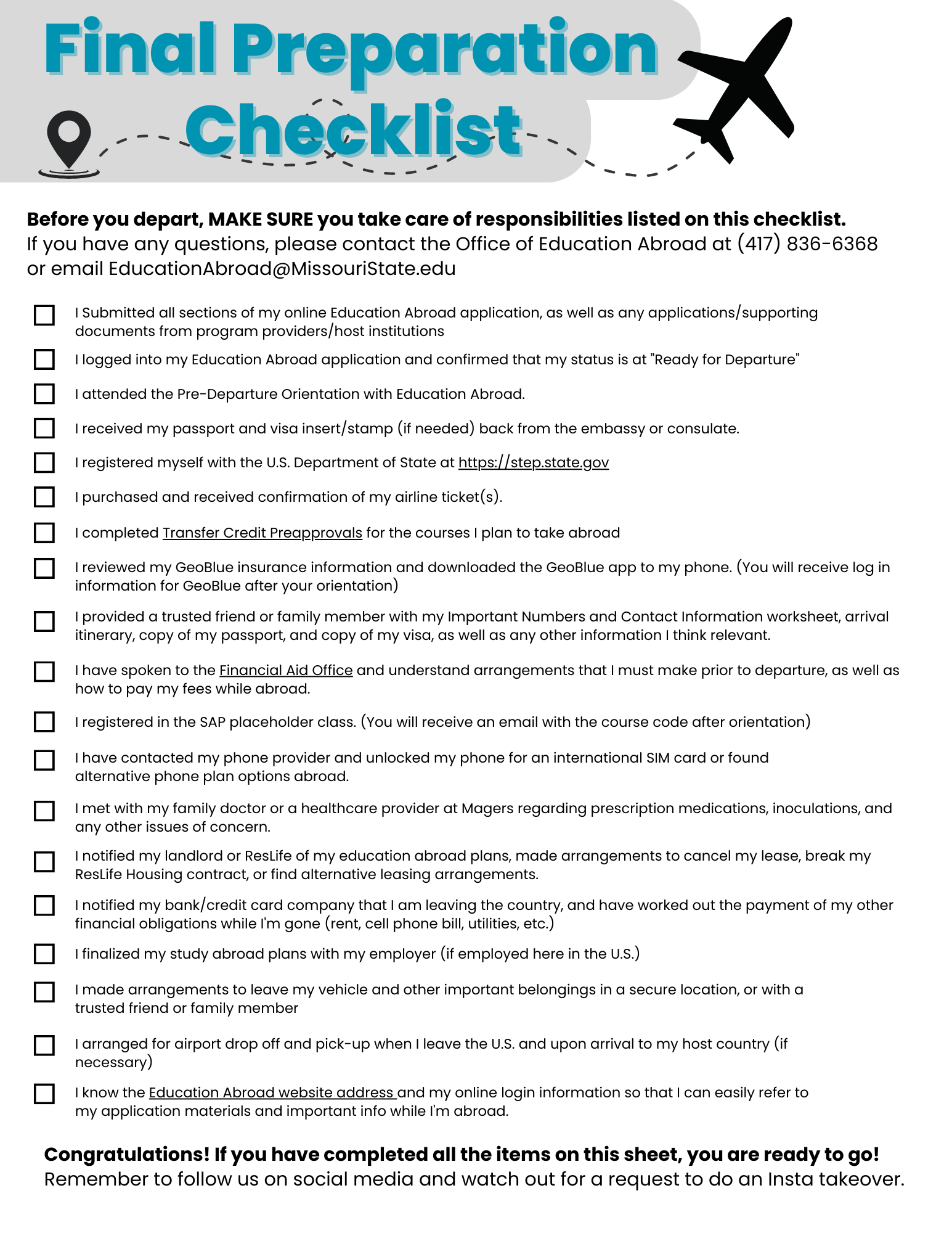
Before you leave, be sure to check that all your important paperwork and documents have been dealt with accordingly. If you forget to even take care of one form, it could result in serious problems.
Course Equivalency Form
Students on all programs (except for the Missouri-London program and short-term programs) must fill out course equivalency forms. This form will pre-approve classes you may wish to take while abroad for Missouri State credit. You must take course descriptions to the appropriate department head, and he or she will then determine if the course matches up with a Missouri State course. Departmental signatures are required for every class you wish to take while abroad, otherwise you may only receive general elective credit for the courses you take. This form is only valid with an official transcript that you will need to have sent to us from your host institution. Course Equivalency Forms can be found in the Study Away Office and in this packet. If for some reason the courses you had approved are not the courses you take, make sure to complete this form as soon as you return. To ease this process, keep as many papers, notes, books, and documents that show what your class entailed.
Passport
If you do not have a passport, you need to get one immediately. You will probably have to have it rushed, which will cost extra. Passport information can be found on the US Department of State’s website.
Visa- TAKE CARE OF THIS ASAP
VISA applications and requirements differ for each individual country. For country-specific information, visit the web and search for your destination country’s information. This will provide you with the VISA information for that country, along with the Consulate’s address and phone number. Make sure that you allow plenty of time to obtain a VISA (if your country requires one) because you will have to send you passport along with your VISA application.
Although VISA applications vary, they all generally require the following:
International Student Identity Card (ISIC)
The International Student Identity Card is required of all students studying abroad through the Study Away Office, and it is included in our office fees. The card provides emergency insurance and discounts for hotels, attractions, travel, memberships, and many other items in the United States and around the world. There is a brochure in this packet that describes its benefits.
Insurance, Medicare & Medicaid, Medical Evacuation
Obtaining medical treatment and hospital care abroad can be expensive, and medical evacuation to the U.S. can cost more than $50,000. Note that U.S. medical insurance is generally not accepted outside the United States, nor do the Social Security Medicare and Medicaid programs provide coverage for hospital or medical costs outside the United States.
If your insurance policy does not cover you abroad, it is a good idea to consider purchasing a short-term policy that does. There are health insurance policies designed specifically to cover travel. Many travel agents and private companies offer insurance plans that will cover health care expenses incurred overseas including emergency services such as medical evacuations. The names of some of the companies offering short-term health and emergency assistance policies are listed on the Bureau of Consular Affairs website at http://travel.state.gov/travel/tips/brochures/brochures_1215.html.
Bringing Medications or Filling Prescriptions Abroad
A traveler going abroad with a preexisting medical problem should carry a letter from the attending physician, describing the medical condition and any prescription medications, including the generic names of prescribed drugs. Any medications being carried overseas should be left in their original containers and be clearly labeled. Travelers should check with the foreign embassy of the country they are visiting to make sure any required medications are not considered to be illegal narcotics. (A listing of foreign embassies and consulates in the U.S. is available on the Department of State’s website at http://www.state.gov/s/cpr/rls/dpl/32122.htm. Foreign embassy and consulate contact information can also be found on the Country Specific Information for each country.)
If you wear eyeglasses or contacts, take an extra pair with you. Pack medicines and extra eyeglasses in your hand luggage so they will be available in case your checked luggage is lost. To be extra secure, pack a backup supply of medicines and an additional pair of eyeglasses in your checked luggage.
If you have allergies, reactions to certain medications, foods, or insect bites, or other unique medical problems, consider wearing a “medical alert” bracelet. You may also wish to carry a letter from your physician explaining required treatment should you become ill.
Information on filling a prescription abroad and other health issues may be found at http://travel.state.gov/travel/tips/brochures/brochures_1215.html.
Women: if you are taking an oral contraceptive or using another prescription birth control method, please plan on taking a large enough supply of the contraceptive to last the entirety of your trip. You may want to consider bringing extra as well, in case some is lost or stolen.
Short Term Healthcare Insurance Providers
Many health insurance companies do not cover or seldom cover emergencies or normal care coverage overseas, unless it is purchased in addition to the standard coverage. Before you leave to study away, call your insurance provider and ask what its policy is regarding overseas care. If it does not cover overseas care, you will need to purchase a short term policy.
You may also want to check the country’s or school’s policy on health care services. Be aware that some foreign healthcare providers (doctors and hospitals) may require cash payment prior to providing service.
Some study away programs do offer a medical insurance plan. Check with your program to find out what it offers and requires. Do not assume it includes one.
When choosing an insurance plan, consider all your needs and what you can afford to pay for the policy and what you would not be able to afford if you faced a medical emergency or even health issue abroad.
The following is a list of overseas healthcare insurance providers. The Study Away Office and Missouri State University do not endorse any of the following. It is for your information only. You are solely responsible for choosing a healthcare policy and enrolling in it.
It is important to stay healthy while you are studying away. Catching the flu or even dealing with a sore throat has the potential to ruin a trip. Realize that medical care abroad will be much different than in the United States. Before you leave (or as soon as you arrive) find out how to see a doctor or receive medical attention. If you get sick, you’ll already be prepared to get help. Don’t assume you will be able to buy the same medications you use at home. If you are sick and want medication, try talking to a pharmacist. S/he may not give you what you expect, but it is probably what everyone in that country uses and could very well work. Just exercise caution and don’t use something that seems dangerous. (You might need to bring someone who can translate to the pharmacy). Learn what the pharmacy symbol is in the country you are visiting, and realize that most pharmacies are not open 24 hours a day as they are in the United States.
Guidelines
Below are some general guidelines for all students. To find out about specific inoculations that may be required to enter your host country or countries in which you may wish to travel, consult the Public Health Service in your area. They can direct you to a clinic for advice and for any necessary inoculations. You may also consult the United States Centers for Disease Control and Prevention (CDC) (http://www.cdc.gov/) or the World Health Organization (WHO) (http://www.who.int/).
Documentation Any inoculation should be recorded with the officially approved stamp on the yellow form International Certificate of Vaccination as Approved by the World Health Organization. Forms or cards that are not properly stamped are not acceptable to health authorities in many countries.
Timing Since many inoculations require more than one visit to the clinic or cannot be taken in combination with others, it is recommended that you begin your inquiries well in advance of your departure.
Medic Alert Emblem
Be sure to wear a Medic Alert emblem (recognized internationally) for a specific medical problem. In how many languages can you convince a nurse that you are allergic to a medication and not just afraid of a needle? For more information, contact the MedicAlert Foundation International at 1-800-344-3226 or visit their Web site (http://www.medicalert.org/).
Medical Records
While living and traveling abroad, it is a wise precaution to keep personal medical records with you to be used in case of an accident or illness. A good medical record will mention ALL drugs you are taking, including any not related to disease, and identify any chronic ailments, allergies or hypersensitivities. It will also list your immunization history, blood type, eyeglass prescription, personal physician, health insurance (along with the number of the policy) and, if pertinent, your religion. Be sure to make a photocopy of your medical records in case of loss. Carry these documents in a place that is both secure and accessible by you at all times while traveling.
Medicines
Prescription Medicine: If you take prescription medicine, you should research whether it is available in your host country and bring a copy of the prescription for the generic name of the drug. In developed countries, you will need to take only an initial supply of the medication; in most developing countries, you will want to take a supply that will last your entire stay.
For customs purposes, take all medicines in their original containers.
There are a number of precautions you can take while abroad to ensure that you stay healthy. Here are some basic pointers:
Neither the Study Away Office nor Missouri State University endorses the use of illegal drugs and alcohol. Nevertheless, we are aware that some students will choose to partake in these activities, whether they are illegal or not in their host country. Should you choose to use alcohol or drugs, please abide by these tips:
Prescription Drugs
Some people may be interested in buying cheap prescription drugs while abroad. Know FDA requirements on all drugs, and understand that there are certain drugs you may be able to buy abroad that are illegal in the United States. Be leery of buying prescription drugs or medications abroad.
If you are a vegetarian, you’ve probably considered your dietary needs and how they will be met when you are away. If you plan to maintain your vegetarian lifestyle, make sure you know what will be available to you when you are in your host country. While some countries, such as Japan or the United Kingdom, have a growing population of vegetarians, not all countries will be able to accommodate you. Be aware of where you can go and what you can eat when traveling. Don’t be afraid to pack some snacks in case you are worried. You may find that maintaining a vegetarian diet abroad can be a challenge since many countries use meat as a staple of their cuisine. It may be difficult to obtain enough quality fruits and vegetables to maintain a healthy diet, and meal plans may or may not include vegetarian offerings.
We want you to have a fantastic experience when you are away from Missouri State, but we also want you to return home in one piece. As you prepare for your trip, make sure you’ve researched the culture to which you are headed. Be prepared for what to expect, and be sure to behave safely so that your trip isn’t ruined by one bad decision. Be aware: our students have had computers, cameras, and numbers of other belongings stolen while abroad. While crime does tend to be higher in the United States then in many other countries, petty theft is rampant across the world. As a foreigner, you make an easy target. Be intelligent.
MONEY AND VALUABLES
Do not carry large amounts of cash around with you; carry traveler's checks and major credit cards instead. Keep your passport and money safe in a money belt or small purse that can be worn underneath your clothing. Wearing a purse on the outside highlights where you keep money and valuables; moreover, it can easily be cut or ripped from your shoulder. Many thieves will simply grab the bag and run, sometimes breaking arms in the process. If possible, don't carry a handbag at all. Wrapping rubber bands around your wallet can make it difficult for a pickpocket to remove.
Do not take valuable items on your trip.
Guard carefully at all times your passport, visas, and other documents that you carry with you, and do not leave them in the outer flaps of your bags. It is better to have to dig for them the few times you will need them, than to leave them out for anyone to steal. Before leaving, make a copy of the identification page of your passport. Keep this copy separate from your passport and carry it with you at all times. If local law does not require you to keep your passport with you, carry only the photocopy of your passport when you are out and about and leave the passport in a secure place in your room.
As you're preparing for your stay abroad, remember to make preparations for your personal safety as well. While abroad, you should take the same common-sense safety precautions that you would at home: be aware of your surroundings and keep your valuables concealed. Many travelers fall victim to crimes because it is assumed they are carrying cash, and in a foreign environment, they are often easy to distract. Be prudent when meeting strangers, and listen to safety advice from your ISEP coordinator and local residents. Remember, most incidents happen when you are careless.
If you should fall victim to crime, remember that your embassy is there to help you. Every embassy and consulate has a duty officer on-call around the clock to assist in an emergency.
WHEN TRAVELING
OUT ON THE TOWN
AVOIDING SEXUAL ASSAULT
We often let our guard down when we're with people we know. Unfortunately, most sexual assaults involve people who know each other. These tips can help you identify danger and protect yourself in any situation.
Basic Tools:
In Social Situations:
SELF-DEFENSE TIPS
At home:
While walking:
Emergency Phone Number: 202-501-4444
State Department Switchboard: 202-647-4000 (after hours emergencies, Sundays, and holidays.) Call this number and ask for the country desk and ask for the OCS (Overseas Citizens Services) duty officer.
Consular Affairs 202-647-3600
After Hours Duty Officer 202-647-1512
Website: http://travel.state.gov/travel/
State Department Website for Students Abroad: http://www.studentsabroad.state.gov/
Email: studentsabroad@state.gov
As the time approaches for spring or summer breaks, many college students are getting ready for that much anticipated trip abroad. Most will have a safe and enjoyable adventure, but for some, the trip will become a nightmare. A number of vacations are ruined by one or more of the following: drugs, alcohol, disorderly behavior, or preventable accidents.
Each year, more than 2,500 American citizens are arrested abroad—about half on narcotics charges, including possession of very small amounts of illegal substances. A drug that is legal in one country may not be legal in a neighboring nation. Some young people are victimized because they are unaware of the laws, customs, or standards of the country they are visiting.
Besides drugs, alcohol can also cause trouble for U.S. citizens traveling abroad. Students have been arrested for being intoxicated in public areas, for underage drinking, and for drunk driving. Disorderly or reckless behavior is to be avoided. In many countries, conduct that would not result in an arrest in the United States may constitute a violation of local law. Some young Americans go abroad assuming that local authorities will overlook such conduct, believing that they are immune from prosecution in foreign countries because they are American citizens. The truth is that Americans are expected to obey all of the laws of the countries they visit, and those who break these laws could face severe penalties, including prison sentences.
Being arrested is not the only misfortune that can occur on a foreign vacation. Young Americans have suffered injury or even death from automobile accidents, drowning, and falls, in addition to other mishaps. While these accidents are sometimes chance occurrences, many are caused by alcohol or drug abuse. Sadly, other Americans have been sexually assaulted or robbed because they have found themselves in unfamiliar locales or are incapable of exercising prudent judgment while under the influence of drugs or alcohol.
Other hidden safety issues are of major concern as well. Because standards of security, safety and supervision are not the same in many countries as they are in the U.S., many young persons have died after automobile accidents, after falls from balconies or into open ditches, by drowning in the ocean as well as in hotel pools, and in water-sports mishaps, among others. In some countries, the water sports industry is not carefully regulated. Unlicensed operators have been linked to assaults, and a number of Americans have been killed or injured by the improper use of jet-skis and other personal watercraft. Although it is crucial that young Americans be aware of these safety risks as they are enjoying their time abroad, it is also important to remember that prudent behavior may help minimize these risks.
Young Americans traveling abroad should remember that the use of drugs or alcohol or engaging in reckless behavior while in another country can do more than ruin their vacation; it can land them in a foreign jail, cause them to suffer physical harm, or worse. Common sense should prevail in any activities young Americans engage in so that safety hazards may be minimized. It is possible to have a safe and fun trip if risky behavior is avoided and familiarity is attained with the basic laws and customs of the country that is planned on being visited.
In addition, even if a passport is not required to visit a foreign country, U.S. Immigration requires that U.S. citizenship and identity must be proved to reenter the United States. A U.S. passport is the best proof of U.S. citizenship. More information about traveling abroad is available at the Department of State's web site: http://travel.state.gov/travel/living/benefits/benefits_1242.html.
For further information contact:
Bureau of Consular Affairs
Office of Public Affairs
Press Inquiries: (202) 647-1488
Internet address: http://travel.state.gov/
Public Inquiries: toll free (888) 407-4747
The best things in life are free, but travel does not come cheap. It is advisable to follow these tips to make the most out of your money and to keep your belongings and important documents safe:
DO plan a budget around the amount of money you are going to have. You may need to edit this appropriately after a few weeks of living abroad.
DO expect to spend more money when you first arrive than at any other time. You will not know where to find bargains and you may need to stock up on items like toiletries.
DO check the exchange rate often as it may fluctuate. The exchange rate will take some getting used to.
DO obtain a bit of paper currency before you leave home.
DO learn the currency, especially the coins, as quickly as you can. One easy way to spot a tourist or foreigner is if they know the money system. You’ll be less likely to be taken advantage of if you can learn it quickly.
DO notify your bank and card companies that you will be abroad—tell them how long you are going to be gone and where you will be. If you plan to travel while studying abroad, you may want to notify your bank every time you leave.
DO record bank phone numbers and keep them in a safe place in case you need to notify your bank from abroad. Call your bank as soon as possible if cards are lost or stolen.
DO memorize your pin numbers or write them down and store them in a safe place.
DO find out your bank’s policy on international card use, whether it is in ATMs or in stores and restaurants.
DO be sure to know what your bank’s transaction’s fees are for using another bank’s ATM.
DO withdraw cash from ATMs for the most current exchange rate; however, only do this periodically (i.e. once a week or less) as you may be charged for international card use. ATMS can often be found at train stations and airports, and at most local banks.
DO KNOW WHAT THE NAME FOR ATMs ARE IN THE COUNTRY YOU VISIT.
DO have a plan for receiving emergency money from home.
DO record all numbers of traveler’s checks if you plan on using them.
DO consider bringing an emergency credit card with you.
DO always, no matter what, lock your doors and windows when you leave.
DO carry a driver’s license for identification. You should also keep your student ID or ISIC card with you in case venues give student discounts.
DO take a money belt or other hidden pouch to keep valuables safe when traveling. (But remember not to let it be seen in public.)
DO remember that Visa really is the most accepted credit card. Master Card, American Express, and Discover are rarely, if ever, accepted. Make sure to keep a copy of credit card numbers at home with a friend or relative.
DO save some currency as a souvenir.
DO be aware of how much money you actually have. This way, you’ll know if anything is missing and you also will not over spend.
DO NOT carry large amounts of cash on your person.
DO NOT keep large amounts of cash in your apartment, hotel room, etc.
DO NOT take all cards with you at all times. Keep one on your person and one in your apartment if possible.
DO NOT keep valuables in plain sight. Always keep these items in a locked suitcase or drawer when you are not in your apartment.
DO NOT carry your passport with you regularly. Only use this when you need to.
DO NOT count money in public. Try to be discrete about any money and valuables on your person.
DO NOT leave windows or doors unlocked, even if you stay in your apartment building.
DO NOT forget to write down your expenses. You don’t want to be overdrawn abroad. Keep track of your accounts through online banking, but don’t forget to log out so no one else sees your information.
DO NOT take large amounts of money or other valuables out if you will be consuming alcohol or drugs. Make sure you ALWAYS bring some form of ID.
DO NOT BE STUPID WITH YOUR MONEY! KEEP IT SAFE AND SPEND IT WISELY!
When you are studying away, you will definitely want to keep in touch with your friends and family. It is important for them to hear from you so they know you are safe, and it is also comforting to hear your friends voices if you are homesick. Make sure that you always have a way to contact someone if there is an emergency and they always have a way to contact you. Email, Facebook, Weblogs, and services like MySpace are a great way to stay in touch. You may also want to get a photo sharing site, of which there are many from which to choose.
Skype
Former study away participants highly recommend Skype. If you have access to a computer or take your laptop with you, it is the cheapest and easiest way to communicate. Skype is an internet phone and messaging service. You will need a microphone for your computer, but Skype is free if you call other Skype users over the internet, or you can use it to call landlines and regular numbers for a small per-minute fee. For more information, see http://www.skype.com/. (You may have to teach your parents to use it, but it will save everyone a lot of money if you can.)
Messaging and Live Chat Services
If you are in a relationship or simply want to see your friends as you talk, you may want to get a webcam. You can use it with Skype or another messaging service. (Usually MSN’s LIVE service has better video quality.) This is a great way to feel connected to those at home.
While messaging is always nice, don’t lock yourself away in your room or apartment and spend hours online chatting to people at home. You want to stay connected, but don’t forget to experience the culture of where you are at the same time.
International Phone Cards
Using a refillable international phone card is a fairly convenient and affordable way to call home. Be sure you know how to use it and you know what the rates are before you leave. Most calling cards have different numbers to dial depending on the country from which the call comes. Make sure you know those numbers before you get on the plane! Be aware that they might not work on some public phones (in airports, for example) and that using the phone may be very expensive. (One student made a $50 call from the Amsterdam airport and didn’t know how much it cost until she received her credit card bill.)
Listed below are a number of International Calling Card Company Websites. The Study Away Office and Missouri State University do not endorse any of the companies listed. They are for your information only.
Cell Phones
There are many options when it comes to using cell phones overseas. You may want to get a phone here and use it abroad, although that can be expensive and the phones may not always work. You can check with your own cell phone provider before you leave to see what their options are, or you can purchase a plan from a different provider. The Study Away office is often sent information from companies eager to help you in your study away adventure. We have received information from three cellular phone companies that have special rates for students traveling abroad and I am passing on this information for your consideration. The companies are as follows:
ISIConnect – Available through Council Travel, check http://www.isic.org/ for information.
UniverCell – Global Cellular phone rentals – check http://www.rentalcell.com/ or call (800) 765-2355 x 8146 for information.
Telestial – through GSM global wireless – no brochure, but website has a lot of information; http://www.telestial.com/.
TMobile – http://www.cellularchoices.net/tmobile-phones.html
A better option for most students is purchasing a SIM card in your host country. This is almost always more affordable, especially if you make friends in your host country and they want to call you. Most students rely on texting while abroad, as it is much cheaper than actual phone calls. Most cell phone providers will sell you a SIM card, and sometimes even convenience stores and supermarkets sell them as well. Try to avoid signing a contract—using a refillable SIM card will ensure you do not pay for more than you need, and it will avoid any hassles involved with signing a contract.
If you choose to buy a SIM card, you will need a phone that works on the frequency of your host country. To find out if your current cell phone works, check the following: what frequency is used (GSM or CDMA), if your phone works on that frequency, and if it is unlocked. If your phone will work and it is not unlocked, your provider might unlock it for you or you could pay someone at a cell phone retailer to unlock it. You could also try to borrow or buy a phone from a student who previously studied abroad or try to find one on eBay. In all reality, it may be easier to buy a phone in your host country, especially since it will come with a charger compatible to the electrical power outlets in the host country. Avoid buying a phone that requires you to purchase a contract—it often causes more hassle in the end.
If you choose to have a cell phone abroad, avoid calling the United States from your cell phone. While traveling, use an international phone card with your cell phone if needed. Encourage your family and friends to call your cell phone, but also make sure they are using an international calling card or an international calling plan from their landline.
When packing for your study abroad semester or year, pack as light as absolutely possible.With luggage requirements and fees, it can become quite a hassle to bring as much as you might like to. Here are a few tips to help minimize your packing.
Weight. The lighter, the better. You never know where you are going to have to carry your luggage, and if you end up having to run through an airport or train station, you will be glad your suitcase is not too heavy.
Documents. Make sure all important documents are with you in your carry-on luggage. Have copies of your passport at home and in your luggage. Make sure you have copies of credit cards and serial numbers (for MP3 players, etc.) at home.
Clothing. Pack everything you think you need, and then remove half of it. You will not need everything you pack, and you don’t want to take something you’ll only where once or twice. Plan on hand-washing small items like socks and underwear more often. Contrary to popular belief, you do not need to wash all clothes after every wear. Consider using fabric freshener like Febreeze if clothes are not too dirty. Enable yourself to layer clothing. This way you can pack several more small items. Bring fewer pairs of pants, as these can be worn several days in a row. You will probably want to buy clothes in your host country. It will help you fit in and makes a good souvenir when you return home. Plan to take only a few essential items and buy other items, like accessories or scarves, while you are away.
Jeans. Make sure you take at least two pairs of nice jeans. They are almost always more expensive abroad than they are at home.
Seasons. Consider the seasons while you are gone. In the southern hemisphere, seasons are the opposite of what they are here. If you are going in the summer, only bring one sweatshirt or coat in case of cold weather. You will not need to use it much and these items take up a lot of space.
Dressing up. Do bring dress clothes, but chances are you will not need to wear them that often. Try only bringing one or two “dressy” outfits unless will have a job or internship.
Shoes. You will not need nearly as many shoes as you might think you will.
Extras. Think in terms of what you can do without. Things like heavy coats and extra blankets may not be entirely necessary. Consider buying these items after you have gotten to your destination to see what you may necessitate while you are there. The same goes for items such as hair dryers and curling irons, which will require different prongs for the outlet anyway.
Souvenirs. Consider that you may want to bring souvenirs home. Leave space in your luggage when you leave, or plan on not bringing certain items home. You also might like to buy clothing while you are away as well.
Luggage requirements. Make sure and check all luggage requirements with your airline before you arrive to check in. Weigh your luggage before you go to be sure it fits into requirements.
Packing is not a one-day exploit. Be sure to give yourself a few weeks to set out items you may want to take and repack as many times as you need to.
Culture shock is nearly unavoidable; however, knowing what to truly expect over having a fanciful idea of your host country is important. Keep these concepts in mind when you enter your new home. Before you go, do your best to research the other culture to help you minimize any surprises. Also, remember that just as much as we are different, we are also very much the same. You may be surprised at how similar a new country is to the United States one day, and shocked at the differences the next day.
Culture refers to values, beliefs, customs, and other forms of behavior shares by members of a social group over a period of time. It is part of everyone’s identity as something that cannot be taken away. It is important that you respect the culture around you. It can be very exciting immersing yourself into this culture to learn more about the people in it. Do your best to research the cultures of your host country so you will know what to expect and therefore minimize culture shock.
Be aware of religious beliefs, political beliefs, moral issues, gender issues, and racial concerns. People may have differing opinions than you, but respect them and listen to them anyway. As an American abroad, you may be discriminated against simply due to your roots. In some countries, discrimination based upon race, religion, sexual orientation, etc. is still very rampant. Do your best to maintain your identity, but keep in mind that there may be times when you will not be as free to speak out as you are in America. Be respectful and do not draw attention to your major differences among strangers. As you make friends, they will be more eager to learn about these differences. This will help you cope with your new culture.
Other ways to cope with culture shock include sharing your culture with others, making many new friends and acquaintances, seeking solace from other American students you may know from your program, keeping a journal or photo album of your travels, communicating with family and friends regularly about your new culture, getting involved in an activity which you may not be able to do in America, and improving your language skills.
Another problem among many students who study abroad is reverse culture shock. Re-entry into America can leave you feeling depressed, disconnected, and disoriented. While you may feel as though you have missed out a lot, take time to reconnect with friends and family, sharing stories. They will want to hear what you have experienced, but keep in mind that they may lose interest at times. Make scrapbooks or albums of your experience, or write about your time abroad. Know that your friends and family do care about you, it will simply take a bit of time to get used to the idea of living at home again. Try to keep in touch with friends you have made abroad, and certainly consider going back to visit.
At Missouri State, you can also get involved with the Study Away Organization. It consists of students who have studied away, students who want to study away, and international students on Missouri State’s campus. It is a great way to make friends who have had similar experiences to yours as well as an excellent mechanism for involving yourself with the international community on campus.
*Missouri State University, The Study Away Office, and our vendor programs do not tolerate discrimination. Consult Missouri State’s Non-Discrimination Policy Statement, found at http://www.missouristate.edu/equity/nondiscrimination_statement.htm
Many students take the opportunity to travel while they are abroad. Traveling is one of the greatest benefits of studying away—once you are in your destination, traveling to nearby countries or cities will be more accessible and less expensive. When you plan your trips, be sure to research the location and always find a good map. Always follow safety measures when traveling and DO NOT GO ALONE!
For research only. These companies are not endorsed by the Study Away Office
Other Sources of Information
Besides guidebooks and advice from other students, you can also find information online. Look for online message boards to find current information. Check sites like wikitravel.org as well, as people update it quite frequently. If you are looking for a place to eat, drink, or dance ask a local your age. Worldwide, most young people speak some English, and they will have a better idea of where the best pizza, music, or club scene is than a guidebook written by someone much older than you.
Remember…
Always let friends and family at home and in your host country know when you are traveling. Give them an itinerary and the contact information of where you will be staying. If there is an emergency, it will be easier for them to contact you. While you are traveling, it will be difficult to keep in touch with family and friends. Use internet cafes or hostel computers to check your email. Try not to use your cell phone unless there is an emergency, as it will be very expensive. If you are in a country for a long period of time, you might consider buying a new SIM card for your phone that doesn’t have a lot of minutes, just so your family can call you if needed.
When you Return
When you get back to your host country, make sure you let your family know immediately so they know you are safe. Also, you’ll need to make sure that you’ve kept up with your school work.
Money
It’s easy to spend too much money when you are traveling. Be careful with your money, and keep a record of your expenses. You may not be able to access your bank account information, and you don’t want to spend more than you have.
We want you to have the time of your life, and these are just some suggestions on how to make your experience great!
Make sure you keep a record of all your important documents and numbers you might need to know. We’ve provided this list to get you started; if you travel away from your university, keep a copy hidden in your bags or somewhere else safe. In your own apartment/room, keep a copy hidden—these numbers are important, but you don’t want anyone else to find them either!
Phone number 417-836-6368
Fax 417-836-6146
Email studyaway@missouristate.edu
Marian Green MarianGreen@missouristate.edu
Overseas Citizen’s Services: 1-888-407-4747
Overseas Emergency: 202-501-4444
After Hours Duty Officer: 202-647-1512
Missouri State University Switchboard: 417-836-5000
Financial Aid Office: 417-836-5262
Office of the Registrar: 417-836-5520
Emergency Hotline: 417-836-5509
*Coverage through STA Travel Insure America Travel Guard International
Toll-free inside U.S.A. & Canada: 1-877-370-4742
Collect from anywhere in the world: 1-715-342-4104